⭐️⭐️⭐️⭐️⭐️⭐️⭐️⭐️⭐️⭐️
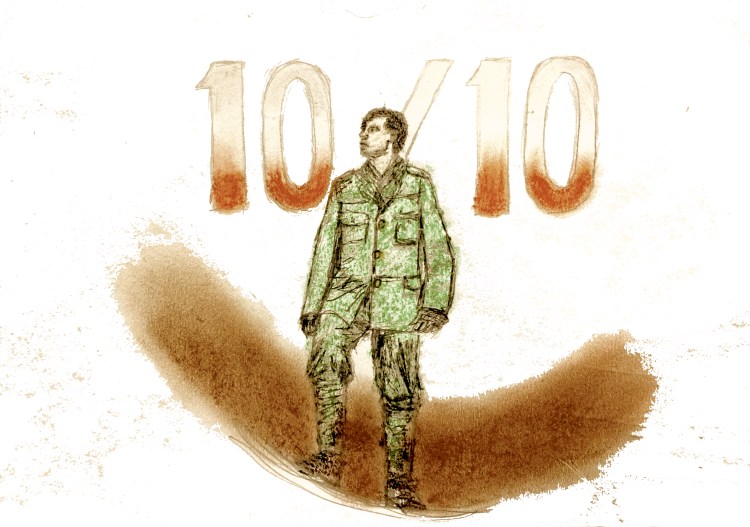
10/10
35mm — 1917 is what cinema was made for. It’s relentlessly impressive, at once innovative and reminiscent of a classic. The bold cinematography pairs with a wholly-satisfying story to create a richly-textured, life-affirming film.
Although it successfully creates the illusion of unstructured reality, it rigorously adheres to rules of narrative. The story couldn’t be simpler: Lance Corporals Blake (Dean-Charles Chapman) and Schofield (George MacKay) are charged with delivering a message across perilous terrain to warn a regiment that they are headed into a trap. Their failure means the imminent deaths of hundreds of soldiers, including Blake’s brother. There’s a task, a series of trials laced with a minefield of shock and suspense, a meditative pause, and a final cranking-up of suspense on the road to resolution. ‘Simple’ is offered here as high praise, for it requires true crafting of the script for a story to be both simple and inherently fulfilling.
As Einstein supposedly said, ‘The definition of genius is taking the complex and making it simple,’ and in 1917, Sam Mendes, with co-writer Krysty Wilson-Cairns, has taken the broadest, most complex themes of all and filtered them down to their purest truths. The characters we meet are both types and individuals: Schofield is the stoic, cynical soldier, ashamed of being awarded for valour and blinded by the war (at one point, literally) to any real value in life. On the other end of the scale, Blake embodies the spirited, young soldier whose love for his family and home lead him steadily onward.
The film’s relatively sparse dialogue – as to be expected in war films, as in war itself – really only serves one of two purposes: to inform and give orders, or to tell stories. It’s a self-reflexive film in the way it emphasises the value of storytelling to human life. Characterisation is arguably developed more through action than speech. What speech really serves to do in the film is represent human connection, reminding us of how it is the backbone to life. The words themselves aren’t important so much as the action of speaking, the comfort of a voice, the desire it indicates to connect.
The illusion sustained throughout of a single-shot is not simply a gimmick employed to win the Academy Award for ‘best cinematography’ (though it almost certainly will) but purposefully enhances the viewing experience. It’s hard not to be taken out of the film at times to guess where shots have been stitched together and to wonder how it’s been done, but this is an easily-forgivable side effect in comparison to the immersion that the apparent seamlessness instils. The camera’s flowing movements are executed like a dance, mirroring those of the actors’ as they fall behind or race ahead of one other. The graceful execution hints at acutely planned and practiced choreography, as there must be with such long takes, yet the attention this draws to its nature as a performance is never detrimental to its illusion of realism.
MacKay and Chapman give powerfully candid and resultantly magnetic performances, outstanding in the way that they carry much of this sweeping spectacle of a film. But, really, the acting of every single soul in each shot is remarkable. As we pass through the tranches, hundreds of lives are glimpsed, each man convincingly suggesting that they have their own story as worthy of following as the film’s protagonists’. One savours a tin of food, another smiles to himself while reading a letter from home, yet another is hunched on the ground, staring into space with a haunted expression. In these brimming shots, there’s the sense that the camera could branch off and follow any one of them.
It does seem like a bit of an inside joke, however, when Richard Madden turns up at the end as Chapman’s brother, both actors performing as kings of rival houses in Game of Thrones and, more ludicrously, meaning to bear close resemblance to one another. These casting issues momentarily take you out the film’s universe. The same effect occurs with the momentarily-suspended reveals of A-list actors such as Colin Firth, Mark Strong and Benedict Cumberbatch. Accumulatively, it feels as if they might have all just decided to get together for a reenactment away-day. This, though, is a pitfall of most major films: casting familiar faces to entice viewers.
In many ways, it could be compared with The Revenant. In terms of theme, grittiness and cinematography, they are brothers. I prefer 1917, however, for its triumph of tenderness and MacKay’s restrained performance. It is an experience that should only really be lived through with IMAX. The visual details recreate a texture of horror in the various landscapes the camera passes through, and contribute to the film’s spectacle, which is perfectly balanced with subtly and introspection. As much as being about the experience of the First World War front-line soldiers, it’s about the life it served to protect, and its symbolism layer conveys this perfectly. The motif of trees in particular serves to evoke themes of connection, peace and hope. Passing through a cherry tree orchard on an abandoned farm, the two soldiers find that each and every tree has been chopped down. But, Blake informs Schofield with triumphant satisfaction, at least double will grow back when the scattered seeds grow. The final image sees Schofield resting up against a lone tree with a hollow trunk and broad green boughs, symbolising his redemption of spirit. He at last concedes to letting himself remember his family and hope that he might still return to them.
 DEEP FOCUS